By Diane Young August 17, 2026
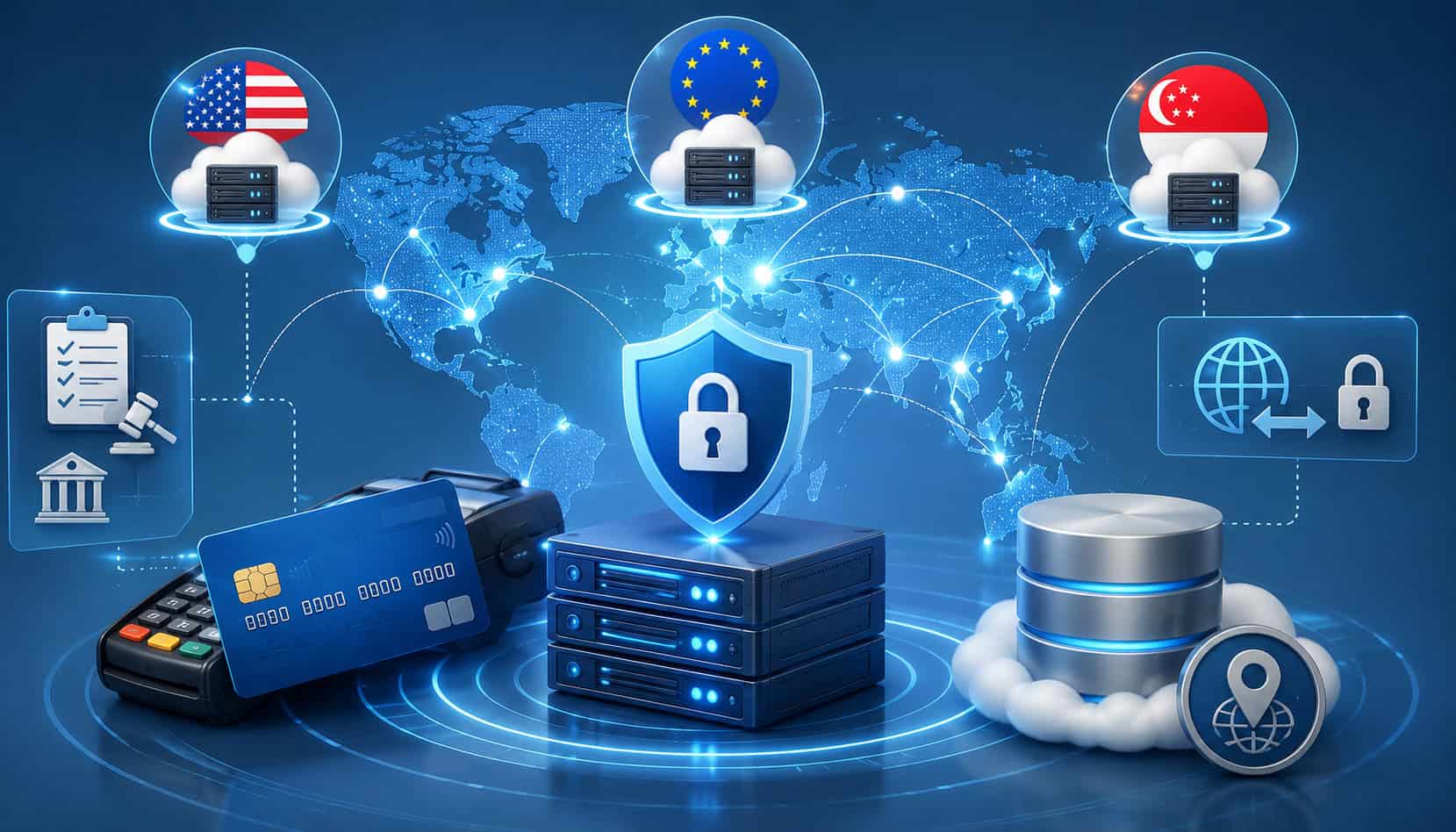
A merchant may host its checkout in one region while cardholder data is processed, tokenized, logged, backed up, analyzed, or supported from several other locations. Choosing a cloud region therefore does not, by itself, prove where all payment data lives.
Modern payment architecture is distributed by design. A browser may submit card information directly to a gateway, the gateway may tokenize it in a vault, the processor may authorize it through separate infrastructure, fraud systems may analyze transaction attributes, and backups or disaster-recovery systems may exist elsewhere.
That makes cardholder data residency a data-flow question rather than simply a server-location question. Businesses need to understand not only where production databases run, but also where payment data is stored, processed, replicated, logged, accessed, recovered, and transmitted.
The legal picture is equally layered. PCI DSS establishes security requirements for environments that store, process, or transmit payment account data, but it does not create a universal rule requiring cardholder data to remain in one country.
Privacy laws, data-localization requirements, card-network rules, processor contracts, acquiring-bank requirements, and cloud-provider architecture can impose additional obligations. PCI SSC describes PCI DSS as a global standard that applies to covered entities regardless of geographic location.
This guide explains how merchants, SaaS platforms, developers, security teams, compliance professionals, and cloud architects can map cardholder data location, evaluate Cross-Border Transfer Rules, and make a defensible cloud payment region selection without assuming that infrastructure configuration alone establishes compliance.
This material is general educational information. It is not individualized legal, privacy, cybersecurity, PCI, or regulatory advice. Requirements depend on the jurisdictions, entities, payment flows, contracts, technologies, and data involved.
What Counts as Cardholder Data?
PCI DSS distinguishes between cardholder data, or CHD, and sensitive authentication data, or SAD. Together, PCI terminology treats these categories as account data.
Cardholder data includes the primary account number, or PAN. When stored with the PAN, cardholder name, expiration date, and service code are also treated as cardholder data. Sensitive authentication data includes full track data or equivalent chip data, card verification codes or values, and PINs or PIN blocks.
The distinction matters because not every piece of information connected with a purchase is necessarily cardholder data under PCI terminology.
A merchant order record might contain:
- customer name
- email address
- billing or shipping address
- transaction amount
- merchant order ID
- device information
- IP address
- gateway transaction ID
- payment token
- truncated card number
- card brand
Some of these fields can constitute personal information under privacy laws even when they are not cardholder data under PCI DSS. For example, California describes certain financial credentials as sensitive personal information and defines personal information much more broadly than payment-card credentials alone.
Sensitive authentication data receives particularly strict treatment. PCI guidance prohibits retaining certain authentication data after authorization, even if the information is encrypted. Businesses should therefore avoid designs that casually capture CVV values, PIN information, or full track data in logs, databases, application traces, analytics platforms, or support tools.
Where Cardholder Data Can Actually Live
Cardholder data may pass through more systems than the merchant realizes. Even when raw card numbers never reach a merchant application server, they may exist within a customer device, gateway infrastructure, token vault, processor environment, backup service, or support workflow.
A typical ecommerce transaction could begin when a customer types a PAN into a browser or mobile app. Depending on the integration model, the card data may be submitted directly to the payment provider or may first reach merchant-controlled infrastructure.
From there, the transaction can involve a payment gateway, payment processor, acquiring bank, card network, issuing bank, fraud platform, token vault, and several operational systems.
For background on gateway architecture, see this guide to cloud payment gateways. The site’s related overview of how cloud infrastructure supports credit card processing also illustrates why payment infrastructure frequently spans multiple technical layers.
Data may also appear in:
- application databases
- object storage
- message queues
- API gateways
- load-balancer logs
- observability platforms
- fraud-detection services
- customer-support systems
- reconciliation databases
- reporting warehouses
- backup repositories
- database replicas
- disaster-recovery environments
- developer debugging tools
This means payment data storage location is only one part of the residency picture. Processing and remote access can matter as well.
For example, a production database may remain in Frankfurt while engineers in another country can retrieve transaction records during support incidents. Under certain transfer frameworks, that remote access can itself be relevant to international-transfer analysis.
The European Data Protection Board specifically identifies remote access from a third country and cloud processing outside the EEA as circumstances that can constitute transfers.
Cardholder Data Location Map
| System | May Contain Cardholder Data? | Typical Purpose | Residency Question |
| Checkout | Possibly | Captures payment credentials | Does PAN touch merchant-controlled code or go directly to the provider? |
| Gateway | Commonly | Routes and secures payment requests | Where are transactions processed and logged? |
| Token vault | Commonly | Stores PAN-token relationships | In which country or cloud region is the vault hosted? |
| Processor | Commonly | Authorization, clearing, settlement support | Which processing regions handle transactions? |
| Logs | Should be minimized | Troubleshooting and monitoring | Can request or response logging accidentally capture PAN? |
| Backups | Possibly | Recovery and continuity | Are backup copies stored outside the primary region? |
| Support tools | Possibly | Customer service and investigations | Which personnel and countries can access transaction data? |
| Disaster recovery | Possibly | Business continuity | Where is data replicated or restored during failover? |
Data Residency, Localization, Sovereignty, and Cross-Border Transfers

These concepts overlap, but they are not interchangeable.
Data residency describes where information is stored or processed. It is often an architectural fact: a database is hosted in a particular region, a token vault is operated in a particular country, or a support function processes records from another location.
Data localization refers to legal or regulatory requirements requiring specified information to remain, be stored, or sometimes be processed within a particular jurisdiction. Localization requirements vary considerably by country, industry, and data type.
Data sovereignty is the broader concept that data can become subject to legal authority based on where it is stored, processed, controlled, or otherwise connected to a jurisdiction. It is a useful governance concept but should not be treated as a single globally defined compliance rule.
A cross-border data transfer occurs when regulated information is transferred or made available across jurisdictions. Depending on the applicable framework, this may include direct transmission, storage with an overseas provider, replication, or remote access.
| Concept | Basic Meaning | Always Legally Mandatory? | Typical Trigger | Architecture Impact |
| Data residency | Where data resides or is processed | No | System design or contractual choice | Determines physical/logical locations |
| Data localization | Requirement to keep specified data locally | Only where applicable law or regulation requires it | Jurisdiction, sector, or data category | May restrict storage or processing locations |
| Data sovereignty | Jurisdictional authority affecting data | Context-dependent | Location, control, entity presence, legal reach | Influences risk and governance decisions |
| Cross-border transfer | Data moves or becomes accessible internationally | Transfer rules may apply | Transmission, replication, remote access | Requires transfer analysis and safeguards |
The practical consequence is important: having cloud payment data residency in one country does not necessarily mean all regulated payment-related data stays there. Nor does storing information locally automatically satisfy every privacy or security requirement.
A business therefore needs to distinguish six separate questions:
- What does PCI DSS require?
- What do applicable privacy laws require?
- Are any data-localization requirements relevant?
- Do payment networks or financial regulators impose additional obligations?
- What has the merchant promised contractually?
- What does the actual cloud and processor architecture do?
Conflating these questions is one of the most common causes of weak residency analysis.
Does PCI DSS Require Cardholder Data to Stay in One Country?

No universal PCI DSS rule requires cardholder data to remain in one specific country. PCI DSS is primarily concerned with securing environments that store, process, or transmit account data and protecting systems that can affect the security of the cardholder data environment.
PCI SSC describes the standard as globally applicable to entities handling cardholder data regardless of geographic location. Its documentation focuses on security controls, scope, storage protection, access, transmission, testing, and related safeguards rather than establishing a universal national residency mandate.
That does not mean geography is irrelevant.
A business operating internationally may still face geographic requirements through privacy laws, local financial regulations, contracts, acquiring relationships, card-network programs, or other sector-specific obligations.
PCI DSS also requires organizations to understand where cardholder data exists. PCI guidance emphasizes limiting unnecessary storage and protecting stored PAN, including copies appearing in backups and logs.
For the authoritative standard and supporting documents, organizations should use the PCI Security Standards Council document library, which currently identifies PCI DSS v4.0.1 as the active PCI DSS publication.
Businesses should therefore avoid statements such as:
- “PCI requires U.S. card data to stay in the United States.”
- “Hosting in the EU makes us PCI compliant.”
- “PCI compliance means our international transfers are lawful.”
- “Our processor is PCI compliant, so privacy-law transfer rules do not matter.”
Those statements combine unrelated compliance questions.
PCI DSS data residency should instead be understood as an architectural and governance issue that interacts with PCI scope, while any legal residency or localization obligation must be evaluated separately.
PCI DSS, Data Minimization, Retention, and Cross-Border Payment Data

PCI DSS does not function as a global privacy-transfer statute, but its controls strongly influence how businesses should design systems that move payment data internationally.
The safest payment architecture generally minimizes where raw PAN can travel. Every system receiving PAN can increase the size of the cardholder data environment, operational complexity, attack surface, and assessment burden.
Security measures commonly relevant to cross-border payment architecture include:
- strong cryptography in transit
- protection of stored PAN
- access controls
- least privilege
- network segmentation
- logging and monitoring
- key management
- vulnerability management
- retention controls
- secure deletion
- service-provider oversight
- incident-response procedures
Encryption matters, but it should not be confused with data removal. An encrypted PAN is still an encrypted representation of PAN. PCI storage requirements continue to address protected PAN rather than treating encryption as if the account number ceased to exist.
PCI guidance specifically calls for stored PAN to be rendered unreadable, including PAN appearing in logs and backup media.
Retention deserves particular attention. Businesses should avoid retaining payment credentials simply because storage is inexpensive or technically convenient.
PCI guidance has long emphasized retaining account data only when there is a legitimate business, legal, or regulatory need. The FTC similarly recommends understanding what sensitive information an organization holds and avoiding unnecessary retention.
Third parties also matter. If a payment processor, gateway, SaaS vendor, or managed-service provider participates in handling cardholder data or can affect the CDE, merchants need to understand the responsibilities allocated between parties.
Privacy Laws and Cross-Border Transfer Rules
Payment transactions can involve substantial amounts of personal information even when raw card numbers are removed from merchant systems.
Examples include:
- customer names
- email addresses
- billing addresses
- shipping addresses
- transaction histories
- device identifiers
- IP addresses
- account identifiers
- recurring-billing references
- fraud scores
- merchant-customer relationship data
Consequently, payment tokenization can reduce exposure to PAN without eliminating privacy-law obligations surrounding other transaction information.
Cross-border privacy rules differ significantly among jurisdictions. Depending on the applicable law, international transfers may require mechanisms or conditions such as contractual safeguards, adequacy findings, assessments of the destination country’s protections, government approvals, local copies, transparency notices, consent in particular circumstances, or other controls.
No single transfer mechanism works globally.
A useful data transfer impact assessment begins by documenting:
- what information moves
- the exporting jurisdiction
- the receiving jurisdiction
- why the transfer occurs
- the recipient’s role
- whether subprocessors receive the information
- applicable transfer mechanism
- technical protections
- retention period
- onward-transfer conditions
- relevant government-access considerations
The objective is not simply to produce a legal document. It is to make the transfer architecture understandable.
That matters because an organization cannot meaningfully evaluate international data transfers without knowing its actual destinations. Data maps should therefore reflect storage, processing, remote support, backups, analytics services, fraud vendors, and disaster recovery.
EU/EEA and UK Cross-Border Transfer Concepts
Under the GDPR framework, organizations transferring personal data outside the EEA must determine whether the transfer is permitted under the applicable international-transfer rules.
At a high level, transfers may be supported by an adequacy decision or, where appropriate, safeguards such as the European Commission’s Standard Contractual Clauses. The Commission maintains official information and current materials concerning Standard Contractual Clauses for international transfers.
Using SCCs is not simply a box-checking exercise. The European Data Protection Board’s recommendations on supplementary measures describe a process that includes mapping transfers, identifying applicable transfer tools, assessing destination-country circumstances, identifying supplementary measures where necessary, and periodically reevaluating transfers. The EDPB expressly notes that remote access from a third country can constitute a transfer.
The United Kingdom has a separate restricted-transfer framework. The ICO explains that organizations may use the UK International Data Transfer Agreement or the UK Addendum to the EU SCCs where those instruments are appropriate, and it also discusses transfer risk assessments. The current guidance is available through the ICO’s international transfer resources.
These examples illustrate why cardholder data cross-border transfer analysis needs both legal and technical participation. Counsel cannot assess an unknown architecture, and architects cannot determine legal transfer requirements from topology alone.
State Privacy Laws and Payment Information
U.S. state privacy analysis requires similar care because “payment information” should not be treated as a single universally exempt category.
Some statutes contain exemptions for information governed by particular federal financial laws, specific regulated entities, or particular processing activities. Those exemptions differ in scope. An exemption for one regulated dataset does not necessarily remove unrelated ecommerce information, device data, customer-profile information, or transaction metadata from the law.
California provides a useful illustration. The state’s privacy materials identify certain combinations involving financial account, debit-card, and credit-card information as sensitive personal information. California privacy protections also encompass many other categories of information that may surround a payment transaction.
This distinction is especially important for SaaS platforms and ecommerce businesses.
A payment processor may receive PAN for authorization while the merchant retains:
- an order identifier
- customer account information
- delivery details
- fraud-related attributes
- tokenized payment references
- transaction history
- marketing preferences
Even if the processor handles the most sensitive payment credential, the merchant may remain a controller or otherwise regulated party for other data.
For data residency for payment processing, the practical lesson is to map privacy data flow separately from PCI data flow. They overlap, but they are rarely identical.
Payment Data Localization and Data Sovereignty
Some jurisdictions impose specific data-localization or local-storage requirements affecting particular financial, payments, communications, government, health, or personal-data categories.
The exact requirements depend on the jurisdiction and the role of the organization. Some laws focus on local storage. Others regulate transfers, require local availability, impose supervisory access conditions, or create sector-specific infrastructure requirements.
For that reason, claims such as “Country X requires all customer data to remain local” should be verified against the current statute, regulator guidance, payment-regulatory framework, and the organization’s exact role.
Payment systems may also involve rules beyond privacy legislation. A central bank, payment regulator, acquiring institution, or network program may create requirements that affect payment data localization or transaction-processing architecture.
Data sovereignty adds another dimension. Even when information is physically hosted in a selected jurisdiction, businesses may need to consider the legal status of the provider, corporate control, contractual rights, government-access rules, subprocessor relationships, and remote administrative access.
This is why payment data sovereignty cannot be reduced to a map of data centers.
A well-designed architecture review identifies not only “where is the database?” but also:
- who controls it
- who can access it
- who operates the infrastructure
- what entity is the data controller and processor
- which subprocessors participate
- where recovery copies exist
- what contractual commitments apply
- what happens when the architecture changes
Choosing a Cloud Payment Region
Choosing a cloud payment region should be a multidisciplinary decision involving architecture, privacy, security, payments, operations, contracts, and resilience.
Do not begin by asking, “Which region is most compliant?” A region cannot answer that question on its own.
Instead, evaluate at least these factors:
- Applicable legal requirements: Determine whether privacy, financial-sector, localization, or contractual restrictions limit where relevant data may be stored or processed.
- Customer geography: Understand where customers and regulated data subjects are located.
- Processor architecture: Determine whether the gateway, processor, acquirer, and token provider support the desired region.
- Tokenization model: Identify where PAN is exchanged for a token and where the underlying vault resides.
- Transfer mechanisms: Confirm how international personal-data transfers are supported where applicable.
- Latency: Payment authorization is time-sensitive, but latency should be balanced against regulatory and resilience requirements.
- Availability and resilience: Understand the failure characteristics of the selected architecture.
- Disaster recovery: Identify where recovery copies are stored and where workloads fail over.
- Subprocessors: Determine which additional providers receive payment-related or customer information.
- Support access: Identify where administrators, employees, and contractors can access the environment.
- Backup location: Confirm whether backups remain in-region or are copied elsewhere.
- Contractual commitments: Verify which residency controls are actually guaranteed rather than merely described in marketing materials.
For more architectural context, see Choosing the Right Cloud Payment Provider and Cross-Border Payments 101.
Cloud Region Selection Matrix
| Factor | Question to Ask | Why It Matters |
| Legal requirements | Are there geographic restrictions on this data? | May limit architecture choices |
| Processor support | Does the processor operate in the chosen region? | Merchant cloud location may not control processor location |
| Data residency | Which services remain in-region? | Not every cloud service follows identical residency behavior |
| Latency | How far are customers and payment endpoints? | Affects checkout performance |
| Redundancy | Can workloads span independent failure domains? | Supports availability |
| Backup location | Where are backup copies written? | Backups may create additional residency locations |
| Support access | From which countries can staff access data? | Remote access may raise transfer questions |
| Subprocessors | Which third parties receive data? | Extends the processing chain |
| Encryption keys | Where and how are keys controlled? | Affects security and governance |
| Disaster recovery | Where does failover occur? | DR may introduce another jurisdiction |
Cloud Region, Availability Zone, Edge Location, and Disaster Recovery
Cloud infrastructure terminology can create false confidence if different concepts are treated as equivalent.
A region generally refers to a geographic area in which a cloud provider operates infrastructure. An availability zone is typically a separate failure domain within that region. Cloud providers may also operate edge locations, local zones, global services, multi-region products, and separate backup or disaster-recovery configurations.
For example, AWS describes a Region as a physical geographic location containing multiple Availability Zones, while its Availability Zones consist of isolated infrastructure within the Region. Similar distinctions appear across major cloud platforms, although implementation details differ by service.
A workload running across multiple availability zones within one region is therefore not the same as a workload running in two international regions.
Likewise:
- CDN or edge processing may occur outside the application’s primary region.
- DNS and control-plane services may have global behavior.
- backups may use separate locations.
- managed analytics services may follow different location controls.
- security telemetry may be centralized.
- disaster recovery may restore data in another region.
Businesses should review service-specific documentation rather than assuming every cloud product follows the same location settings. Google Cloud, for example, distinguishes regional, multi-regional, and globally available services and instructs customers to check individual product location behavior.
Cloud region compliance therefore depends on the actual services being used, their configuration, and the surrounding legal and contractual requirements.
Processor, Gateway, Token Vault, and Subprocessor Locations
A merchant can carefully choose a cloud region and still have payment data processed elsewhere.
The reason is simple: the merchant controls only part of the transaction chain.
A gateway may tokenize a card in one jurisdiction, store the PAN-token relationship in another, send authorization traffic through processor systems elsewhere, invoke an external fraud service, and provide support through globally distributed personnel.
When evaluating payment processor data storage, ask specifically about:
- production transaction databases
- authorization infrastructure
- token vaults
- logging systems
- fraud platforms
- backups
- replicas
- disaster-recovery sites
- support systems
- analytics services
- subprocessors
Contracts matter here. Marketing statements such as “regional infrastructure” or “local hosting available” may not describe every system.
Review data processing agreements, subprocessor disclosures, security documentation, service descriptions, and contractual residency commitments.
Useful processor and cloud questions include:
- Where is cardholder data stored?
- Where is cardholder data processed?
- Where is the token vault?
- Are backups copied to another region?
- Is transaction data replicated?
- Which subprocessors receive customer or payment data?
- Can support personnel access information internationally?
- Can specific processing locations be contractually restricted?
- How are international transfers handled?
- Where are encryption keys managed?
- What happens during disaster recovery?
- How are region or subprocessor changes communicated?
Tokenization, Encryption, and Card Data Residency
Tokenization can materially reduce exposure to PAN, but it does not automatically remove every PCI, privacy, contractual, or localization question.
In a common gateway-tokenization model, the provider receives the PAN and returns a token. The merchant stores the token and uses it for future transactions while the provider maintains the underlying vault.
Other models include:
- processor tokens
- network tokens
- merchant-generated references
- wallet-related token credentials
Whether a particular token remains relevant to PCI scope depends on architecture, tokenization implementation, systems, controls, and whether the token can be used to retrieve or reconstruct account data. Businesses should avoid a universal statement that “tokens are never cardholder data.”
Tokenization also does not erase privacy considerations. A token linked to a customer profile may still be personal information under applicable privacy law even when it does not expose PAN.
Encryption and tokenization are different.
Encryption mathematically transforms data using cryptographic keys. Authorized systems possessing the necessary key material can decrypt the ciphertext back into PAN.
Tokenization typically replaces PAN with another value while the mapping to the underlying account credential is maintained elsewhere, such as a token vault or network tokenization service.
Accordingly, encrypted PAN should not automatically be treated as equivalent to a merchant reference token.
Key management also deserves independent analysis. Customer-managed keys, provider-managed keys, hardware security modules, and region-specific key services can influence security architecture. NIST’s key-management guidance emphasizes documented policies and controls for cryptographic keying material.
Key location alone, however, does not determine residency compliance. An encryption key stored locally does not prevent encrypted data from being copied elsewhere, nor does it determine whether remote processing constitutes a regulated transfer.
Hosted Payment Pages, SDKs, Logs, Backups, and Support Access
Hosted payment pages and client-side payment SDKs can reduce direct merchant exposure to raw PAN.
In a redirect model, the customer leaves the merchant environment and enters payment details on infrastructure operated by a payment provider. In an iframe or hosted-field model, card-entry components may be supplied by the provider while appearing inside the merchant’s checkout experience.
Client-side SDKs may also tokenize payment credentials before they reach merchant application servers.
These designs can significantly affect PCI scope, but the details matter. Merchants should confirm what browser scripts, application code, network requests, callbacks, and server-side APIs actually do rather than assuming every hosted or SDK integration has the same security implications.
Even when raw PAN stays away from merchant systems, merchants may still retain customer names, billing data, order history, processor references, tokens, chargeback evidence, and fraud information.
Logs deserve special scrutiny.
Payment systems sometimes accidentally record:
- full request payloads
- API responses
- headers
- query parameters
- debugging traces
- user-entered form fields
- support screenshots
A logging platform can therefore become an unexpected payment data processing region or storage location.
Backups create a similar problem. Deleting PAN from a production database may not immediately remove earlier copies from immutable backups, archives, database snapshots, replicas, or disaster-recovery systems.
Support access is equally significant. A database may physically reside in one country while administrators or support personnel access transaction records from another.
For EU transfer analysis, the EDPB explicitly recognizes remote third-country access as relevant to transfers.
Multi-Region, Single-Region, and Disaster-Recovery Architectures
Multi-region payment systems offer meaningful operational advantages.
They can improve:
- resilience
- geographic redundancy
- customer latency
- continuity during regional failures
- scalability
But every additional region can introduce another data-transfer path, replica, support boundary, logging environment, recovery location, and incident-response jurisdiction.
An active-active architecture may process live traffic in several regions simultaneously. This can improve availability, but it may also duplicate transactional information and complicate cross-border payment data analysis.
An active-passive design maintains a secondary environment for failover. Although the secondary system may normally process little or no customer traffic, it still matters if replicated data is stored there.
A single-region architecture can be simpler to map and control. It may reduce unnecessary cross-region replication, but it does not automatically satisfy legal requirements.
Single-region designs also create tradeoffs involving regional outages and business continuity. A merchant should not sacrifice reasonable resilience merely to produce a simpler residency diagram.
Disaster recovery deserves explicit documentation.
Ask:
- Where is backup data stored?
- Where can it be restored?
- Does failover cross a national border?
- Are recovery logs stored elsewhere?
- Do emergency procedures expand support access?
- Are recovery regions covered by transfer mechanisms?
- Does the processor fail over independently of the merchant?
The most defensible architecture aligns legal obligations with operational reality rather than maintaining a “local-only” diagram that stops being true during an outage.
Data Mapping Before Cloud Region Selection
A business should map payment data before making major region-selection decisions.
A practical workflow is:
- Identify payment data elements:. List PAN, expiration date, cardholder name, tokens, transaction identifiers, customer information, billing data, fraud attributes, and other relevant fields.
- Map every receiving system: Include checkout components, gateways, APIs, databases, processors, fraud tools, analytics systems, and support platforms.
- Identify storage locations: Record country, cloud region, data center, or managed-service location where reasonably available.
- Identify processing locations: Data can be processed without long-term storage.
- Identify remote-access locations: Record where employees, contractors, and provider personnel can access information.
- Identify subprocessors: Extend the map beyond the first contracted provider.
- Map backup and disaster-recovery regions.
- Classify legal and contractual requirements: Keep PCI, privacy, localization, network, and contractual requirements separate.
- Document transfer mechanisms: Record the relevant mechanism or review for each regulated cross-border flow.
- Select or modify the architecture: Only after the first nine steps should the cloud-region decision be treated as informed.
Build a Payment Data Inventory
A useful inventory should include fields such as:
| Field | Example Purpose |
| Data element | PAN, token, email, IP address |
| System | Gateway, database, support platform |
| Owner | Payments, engineering, finance |
| Purpose | Authorization, reconciliation, fraud |
| Storage region | Geographic storage location |
| Processing region | Geographic processing location |
| Retention | Business-approved retention period |
| Protection | Encryption, tokenization, masking |
| Third party | Processor, cloud provider, fraud vendor |
| Transfer mechanism | Applicable privacy-transfer mechanism |
| Deletion process | Production, backup, archive treatment |
Payment data mapping should be maintained as architecture changes. New analytics tools, observability platforms, processors, regions, and support vendors can quietly invalidate an old diagram.
Retention, Deletion, Chargebacks, Fraud, and Reconciliation
Payment data retention should be driven by documented necessity rather than indefinite convenience.
Possible retention considerations include:
- accounting obligations
- contractual requirements
- transaction reconciliation
- dispute evidence
- chargeback handling
- fraud investigations
- legal obligations
There is no universal retention period appropriate to every jurisdiction or every payment dataset.
Chargebacks illustrate why merchants often need historical transaction records. A business may need order information, fulfillment evidence, authorization records, communications, and processor references to respond to a dispute.
That does not normally require retaining unnecessary full PAN.
Reconciliation systems offer another opportunity for minimization. Finance teams usually need transaction IDs, processor references, amounts, dates, currency, settlement data, fees, and possibly truncated card information. Raw PAN should not be added to reconciliation pipelines unless there is a validated requirement.
Fraud systems also belong in the residency review.
An external fraud provider may receive:
- transaction amount
- customer identifiers
- device fingerprints
- IP addresses
- addresses
- behavioral data
- payment-related identifiers
Even when the provider never receives full PAN, those transfers can remain relevant under privacy laws.
Deletion must also account for system lifecycle.
Removing a customer record from a production application does not necessarily remove it immediately from:
- database snapshots
- backups
- archives
- replicas
- logs
Businesses should understand whether backup deletion is immediate, delayed until expiration, technically infeasible on an individual-record basis, or governed through scheduled lifecycle expiration.
The result should be reflected accurately in retention disclosures, internal policies, contracts, and response procedures.
Security Controls for Cross-Border Payment Data
Cross-border architecture should not reduce security to geographic location.
A poorly protected database in a preferred jurisdiction is not made secure merely because it is locally hosted. Likewise, strong encryption does not by itself answer localization or privacy-transfer requirements.
A mature security program should consider:
- TLS for network transmission
- encryption at rest
- payment tokenization
- least-privilege access
- multifactor authentication
- privileged-access controls
- centralized access logging
- secrets management
- cryptographic key management
- network segmentation
- secure software development
- vulnerability management
- intrusion detection
- data minimization
- incident response
- service-provider oversight
Access logs should help organizations understand who accessed sensitive payment information, from which system, and under what authorization.
Incident response must also account for geography.
Breach notification or regulatory reporting obligations can depend on factors such as:
- affected individuals’ locations
- type of compromised data
- merchant location
- processor responsibilities
- contracts
- applicable privacy or sector laws
There is no single global breach-notification deadline. Response procedures should therefore include jurisdictional escalation paths rather than relying on one universal timetable.
The FTC’s security guidance emphasizes inventorying sensitive information, protecting data in transit and storage, limiting unnecessary retention, controlling access, and supervising service providers.
Contracts, Data Processing Agreements, and Provider Questions
Technical configuration is temporary. Contracts determine what providers have actually committed to do.
Merchants and platforms should review relevant agreements for:
- data processing roles
- subprocessor lists
- residency commitments
- cross-border transfer provisions
- security requirements
- breach notification obligations
- deletion and return provisions
- audit or assurance rights
- change notifications
- disaster-recovery arrangements
Do not assume a processor’s documentation promises the same thing as its contract.
For example, a provider may allow customers to select a regional database while reserving the right to process telemetry, fraud information, support data, or service metadata globally.
Useful questions for processors and cloud providers include:
- Where is cardholder data stored?
- Where is it processed?
- Where are backups located?
- Is data replicated across regions?
- Where is the token vault?
- Which subprocessors receive payment or customer data?
- Can support personnel access data from other countries?
- Which contractual residency commitments are available?
- How are international transfers handled?
- Can particular regions be contractually restricted?
- Where are encryption keys managed?
- What happens during disaster recovery?
- Can data be deleted from backups?
- How are region or subprocessor changes communicated?
The answers should feed directly into the organization’s payment data mapping, risk register, data transfer impact assessment, PCI documentation, vendor-management records, and architecture diagrams.
Common Cardholder Data Residency Mistakes
Many residency problems begin with assumptions rather than dramatic technical failures.
Common mistakes include:
- Assuming cloud region equals total data location: A database region does not describe gateways, processors, logs, backups, DR, fraud tools, or support access.
- Forgetting backups: Production may remain local while snapshots are copied elsewhere.
- Ignoring logs: Debugging systems frequently capture more information than expected.
- Overlooking support access: Remote administration can matter under some international-transfer frameworks.
- Confusing PCI with privacy compliance: PCI DSS and privacy laws serve different purposes.
- Assuming tokenization removes every obligation: Tokens can reduce PAN exposure without eliminating privacy, contractual, or localization considerations.
- Ignoring subprocessors: Your processor’s vendor may receive customer information.
- Using production card data in testing: Development and QA environments should not casually inherit production PAN.
- Retaining PAN unnecessarily: Storage increases exposure and scope.
- Failing to inspect DR architecture: Failover may move processing to another jurisdiction.
- Relying on marketing claims: “Local cloud” and “regional service” need precise technical and contractual definitions.
- Failing to update data maps: Architecture changes faster than compliance documentation if ownership is unclear.
Data Residency Decision Checklist
| Review Area | What to Verify |
| Cardholder data flow | Every system handling PAN or SAD |
| Privacy data flow | Customer and transaction personal information |
| Cloud region | Location settings for each relevant service |
| Processor region | Where transaction processing actually occurs |
| Token vault | Where PAN-token mappings reside |
| Backups | Storage locations and retention |
| Disaster recovery | Recovery and failover jurisdictions |
| Logs | Whether sensitive fields appear |
| Support access | Countries from which data can be accessed |
| Subprocessors | Downstream vendors and roles |
| Transfer mechanisms | Applicable cross-border safeguards |
| Retention | Documented need and lifecycle |
| Security controls | Encryption, access, segmentation, monitoring |
| Contract commitments | Binding residency and notification provisions |
Frequently Asked Questions
What is cardholder data residency?
Cardholder data residency describes where payment card information is stored or processed across the systems supporting a transaction.
It can include merchant infrastructure, gateways, processors, token vaults, logs, backups, replicas, and disaster-recovery environments. Residency is an architectural fact and should not automatically be interpreted as a legal localization requirement.
Where does cardholder data actually live?
It depends on the payment architecture. PAN may exist temporarily in a customer’s browser, gateway, tokenization service, processor, or acquirer environment. It can also appear unintentionally in logs or backups. A reliable answer requires an end-to-end payment data map.
What is the difference between data residency and data localization?
Data residency describes where data is stored or processed. Data localization refers to a legal or regulatory requirement requiring particular data to remain, be stored, or sometimes be processed within a jurisdiction. Residency can exist without a localization law.
Does PCI DSS require payment data to stay in one country?
No universal PCI DSS requirement mandates that cardholder data remain in a particular country. PCI DSS focuses on protecting account data and systems affecting the cardholder data environment.
Geographic restrictions can arise separately from privacy laws, localization rules, payment regulations, card-network requirements, contracts, or acquiring relationships.
Can cardholder data be transferred across borders?
Potentially, but applicable requirements depend on the jurisdictions and data involved. PCI DSS does not itself establish a universal prohibition on international transmission. Privacy-transfer rules, financial regulations, localization requirements, contracts, and processor policies may impose additional conditions.
Does tokenization solve data residency requirements?
Not automatically. Tokenization can reduce merchant exposure to PAN, but the underlying card number may still reside in a provider’s token vault. The token and associated customer or transaction information may also remain subject to privacy, contractual, or regulatory requirements.
Is encrypted PAN still cardholder data?
Encryption protects PAN by rendering it unreadable without the necessary cryptographic material, but the underlying information remains PAN. PCI requirements address protection of stored cardholder data rather than treating encrypted PAN as if the account number disappeared.
How do I choose a cloud region for payment processing?
Start with applicable legal and contractual requirements, then evaluate customer location, processor support, token-vault architecture, cross-border transfer mechanisms, latency, availability, backups, disaster recovery, support access, subprocessors, and key management. Region choice should follow data mapping rather than precede it.
Do backups count when evaluating data residency?
Yes. A production database may remain in one region while snapshots, archives, or disaster-recovery copies exist elsewhere. Payment data retention and residency reviews should include backup systems and the locations where those backups can be restored.
Can customer support access create a cross-border transfer?
Under some privacy frameworks, yes. The EDPB specifically identifies remote access from a third country as relevant to transfer analysis. Organizations should therefore map both physical storage and administrative or support access.
What should merchants ask their payment processor about data location?
Ask where transactions are stored and processed, where the token vault resides, whether data is replicated, where backups and DR sites are located, which subprocessors receive information, where support personnel operate, and what residency commitments are contractually available.
Are gateway tokens subject to the same rules as PANs?
Not necessarily, but the answer depends on how the token is generated, used, linked, and whether systems can exchange it for PAN. Tokens may reduce PCI exposure while still qualifying as personal or regulated information under other frameworks.
Can a merchant use multiple cloud regions for payments?
Yes, where the architecture and applicable requirements allow it. Multi-region designs can improve resilience and latency but create additional data-transfer paths, replicas, processing locations, and compliance documentation requirements.
How do subprocessors affect payment data residency?
Subprocessors extend the data-processing chain. Fraud vendors, support providers, infrastructure services, analytics tools, and other vendors may receive payment-related or personal information. Their locations, access, roles, and contractual protections should therefore appear in the merchant’s data-flow review.
What documentation should businesses maintain for cross-border payment data?
Useful records include payment data inventories, architecture diagrams, system owners, storage and processing regions, support-access locations, subprocessor lists, retention schedules, transfer mechanisms, security controls, contracts, data processing agreements, risk assessments, deletion procedures, and records of architecture changes.
Conclusion
Knowing your primary cloud region is useful, but it is not the same as knowing where your cardholder data lives.
Payment information can move through browsers, gateways, processors, token vaults, acquiring infrastructure, cloud databases, fraud systems, logs, support tools, backups, replicas, and disaster-recovery environments. Each system can affect the true cardholder data location.
The strongest approach begins with data mapping.
Identify every relevant payment and customer-data element. Trace where it is stored, processed, transferred, replicated, accessed, and deleted. Document the gateway, processor, tokenization provider, subprocessors, backup infrastructure, support model, and disaster-recovery design.
Then separate the governing requirements.
PCI DSS establishes payment-security expectations but does not create a universal national storage rule. Privacy laws may regulate international transfers. Data-localization rules may restrict certain datasets in particular jurisdictions. Processor contracts, card-network requirements, financial regulators, and acquiring relationships may add further constraints.
Finally, treat choosing a cloud payment region as an architecture decision with legal, security, contractual, operational, and resilience dimensions.
A defensible cloud payment infrastructure does not depend on a single “compliant region.” It depends on understanding the full data flow, minimizing unnecessary payment data, protecting what remains, verifying provider behavior, documenting cross-border transfers, maintaining appropriate contractual safeguards, and revisiting those decisions whenever the architecture changes.